
World Kidney Day
1 in 10 Romanians suffers from Chronic Kidney Disease (CKD), yet very few are diagnosed at a treatable stage. Almost half of the people tested in a screening caravan discovered they had kidney stones.
Concerning results from a free screening caravan in Dolj County: nearly half of the individuals tested in rural areas were diagnosed with kidney stones. On World Kidney Day, nephrologists emphasize that Chronic Kidney Disease affects approximately 1.8 million Romanians, with many cases being detected late, often after complications have already developed.
On the occasion of World Kidney Day, specialists highlight the growing impact of kidney diseases in Romania. About 1 in 10 Romanians suffers from some form of chronic kidney disease (CKD), with many cases detected at advanced stages. These are conditions that can, over time, lead to severe complications and even irreversible kidney damage requiring dialysis.
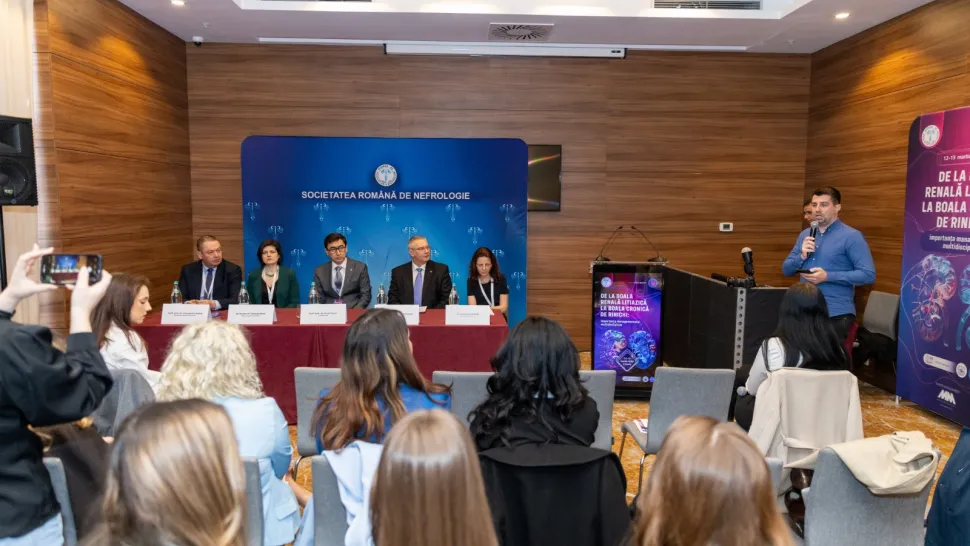
In this context, the Romanian Society of Nephrology, together with the University of Medicine and Pharmacy in Craiova and the Nephrology Clinic of the Craiova County Emergency Clinical Hospital, organized a free screening caravan for kidney stones on March 10–11, held both in Craiova and in rural areas of Dolj County.
Caravan Results
In total, over 130 patients received medical evaluations during the caravan, both in the city of Craiova and in the commune of Goiești.
Most of the evaluated individuals were women – 96 participants – and data analysis reveals significant differences between urban and rural areas.
The average age of patients was 48 years in the urban caravan and 57 years in the rural areas.
In rural areas, 40.9% of individuals evaluated in Goiești were diagnosed with kidney stones, compared to only 10.8% of patients in urban Craiova.
Additionally, 53.8% of urban patients and 37.9% of rural patients were previously known to have kidney stones.
Doctors also identified, in some patients, complications associated with kidney stones, requiring further investigations and specialized monitoring.
Prof. Dr. Ismail Gener, President of the Romanian Society of Nephrology
"We tried to reach out to the community to identify these asymptomatic cases because we are talking about a very common and silent condition that often remains undetected in its early stages. These are perfectly treatable conditions if diagnosed early. Late diagnosis increases the risk for patients both in terms of progression to dialysis or kidney transplantation and cardiovascular mortality. Currently, the renal replacement therapy program through dialysis is the third most costly national program, after oncology and diabetes programs. An early diagnosis can be made with just two simple, free tests, and your family doctor can guide you in performing them. Early initiation of treatment can cure the disease or at least reduce by up to 40% the risk of progression to dialysis and cardiovascular mortality."
Another important outcome of the caravan is that 53% of patients were genetically tested for hyperoxaluria, considering the presence of family history of kidney stones.
Dr. Daniela Cană Ruiu, Caravan Coordinator
"The purpose of the caravan was to bring medicine closer to people, to provide medical education starting from identifying risk factors, to monitor patients, and to reduce the risk of progression to complications and dialysis. Kidney stones or chronic kidney disease are not conditions to be neglected. Patients in rural areas have much less access to specialized medical services, and diagnosis is often inadequate."
Kidney Diseases – A Major Public Health Issue
Epidemiological data show that kidney diseases are a major public health issue both in Romania and globally.
Approximately 10% of Romania’s population suffers from chronic kidney disease, meaning over 1.8 million people. Currently, over 16,000 patients in Romania are dependent on dialysis, and this number is steadily increasing.
Kidney stones are among the most common urological and nephrological conditions, affecting 5–10% of the adult population, with a recurrence rate of up to 50% without preventive measures.
Dr. Daniela Maria, Chief Physician of the Nephrology Clinic at SCJU Craiova
"We face a real problem with patient awareness regarding the risks they face when they do not attend regular check-ups. Sometimes, barriers include time, costs, inability to travel, or patience. Any appointment with a doctor requires time. We can only see patients immediately in emergencies. For other consultations, for chronic diseases, there is a waiting period, and many patients are dissatisfied or see it as an obstacle and give up. Our surprise was discovering new cases of kidney stones and obstructive pathology. The caravan was a success, and I believe we will organize similar events in the future."
Prevention – The Key to Protecting Kidney Health
Specialists emphasize that screening and early diagnosis can significantly reduce the risk of complications associated with kidney diseases, such as recurrent urinary infections, impaired kidney function, or the need for complex treatments like dialysis or kidney transplantation.
Assoc. Prof. Dr. Constantin Kamal, Family Medicine Representative
"Family doctors play an essential role in prevention. Certain high-risk populations should be prioritized for kidney stone screening. Caravans like this demonstrate that solutions exist despite legislative barriers. When patients ask at the end of the caravan, 'When will we see you next?', it is a rare and encouraging sign in medicine."
Screening initiatives like these caravans aim to bring preventive care closer to communities, especially where access to medical investigations is limited.
Prof. Dr. Cristian Gheonea, Vice-Rector of UMF Craiova
"For us, the caravan is not just about screening; it is also about education. Our students and young resident doctors can work directly with patients and understand the importance of prevention. It means early detection, identifying patients at early stages, those at high risk, and early interventions, if possible, to prevent complications. At UMF Craiova, bringing research closer to the patient is not a slogan; it is natural. It is part of our mission and identity."
The results obtained during this caravan confirm the importance of early detection and health education, as well as the need for implementing dedicated kidney disease screening programs.
 Share
Share
Stay up to date with the latest news: key events, industry insights, trends in medical communication, and strategic insights. Subscribe and stay connected to the pulse of the medical field.